

the great responsibility
- wumbo william

- Aug 23, 2025
- 5 min read
Updated: Aug 24, 2025
you've probably heard of the trolley problem before, and seen it presented as such:
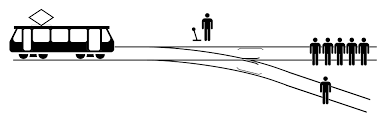
the trolley problem is a classic dilemma in philosophy seen throughout many movies and tv shows in our culture. often presented as a moral dilemma in which you have to choose to kill 1 person to save 5, or vice versa, characters are often supposed to be seen grappling with the complexity of such a choice. such as in the good place, when chidi used the trolly problem to try to educate the demon, michael, on moral ethics.

it's a useful tool when presenting a story in which characters may have to make this choice, whether it's saving the world by killing the bad guy, or dissecting someone with an immunity to a deadly virus. it's an age old tale of something that realistically, most of us would probably have less trouble choosing in real life. most studies done on the trolley problem show variations between countries, with the 82% in the United States saying the first switch flip is completely 'morally permissible', while in China, only 52% said the same. however, most countries worldwide would agree that they'd want to save 5 people instead of 1.
this is all well and great but conveniently, most media leaves out a sneaky little 3rd option for the trolley problem, one in which a large man is pushed off a bridge so that his body blocks the train. yes, this is real.

in this scenario, while there is variation in people's level of comfortability worldwide, almost unanimously does the world agree that the 3rd option is the worst. having to physically push a man in front of a train to save people sounds a lot more evil. there would be a struggle, you'd have to hear the man beg for his life, and you'd ultimately have to time it out so that his body could be dropped in time. it feels a lot more intentional.
but just because something feels that way.. does that mean it actually is?
my point of bringing this all up is that i don't think the trolley problem was ever about whether or not it's better to kill one person to save five. i think most people would agree that if forced to make this choice, they'd turn the lever. but the fact that practically no one would push the man off the bridge indicates to me, that our world views technology, the lever, as a separator in moral ethics. because there's no struggle, you don't have to fight someone and ignore their pleads for help, it's easier to compartmentalize. even though in reality, there is not a moral difference between switching the lever and pushing the man. you are the person choosing to kill one person to save more. is the stress of doing it yourself really what deteremines how immoral an action is?
this might raise a lot of questions in your head about the implications of logic like this on the human race. and that's exactly my point. that brings me to the reason i wrote this at all.
the 'great responsibility' as i have decided to call it
i think technology is not a separator at all in your morals. i think every time we buy a shirt that was made by children in sweatshops, or buy fast food from companies sponsoring war, or consume media from corporations killing people and doing heinous acts behind the scenes, that we are responsible for all of it. we share the blame together.
we tend to put the blame upon the individual, saying if only they recycled, or if only they stopped buying from starbucks, then maybe things could be different. but this is also not a full scope of the problem, especially in western society. since we were born (this is mostly directed at my generation), the moment you were on this planet, you were forced into sin. you were forced into consumption that took advantage of other's suffering. your lunchbox, the spoons and silverware, your shirts, everything. you killed people before you could even comprehend it.
this is not remotely to fear monger. i think our entire planet's moral compass is offset because it is too difficult to think about the implications of responsibility. we also like to turn it towards others and say "no, i do the right things, i don't cause death." we all cause it, even right now, just by being online. by scrolling. we are hurting others for our own pleasure and entertainment.
so this is why i bring up the trolley problem, to demonstrate that technology has completely bended our ethics. we've been desensitized, specifically my generation, Gen Z, since we were born. we were forced into sin before we could even comprehend the complexity of our choices. in this aspect, the good place demonstrates this well, which is why i brought it up earlier.
in that show, they eventually learn that nobody gets into the "good place" anymore, their version of heaven, because Earthly choices have literally become too complicated. every step you take and every piece of media you consume, the food you buy, the clothes you wear, has ramifications that cannot be placed onto the individual. no human can even fully comprehend it. we weren't made to. our brains are still designed on hardware that was meant for smaller communities and smaller moral stakes. so we simplify things down to a mix of moral ethics and comfort, never considering that we share this burden together.
if we are all evil, then maybe evil itself isn't the problem. maybe instead of blaming ourselves or our peers for the consumption problems we face in society, we could come together and realize that we bare this great responsibility together. especially in western society. and that the only way to change it is to change how we treat our children, to help them understand the gravity of their choices before it's too late.
so many people in the united states are suffering and dead inside and they don't know why. and people have individual circumstances of course. but i truly think a lot of it stems from the depths of our souls knowing the truth. that our self pleasure has been killing others since the moment we were born. instead of turning our heads away and assuming it must not be a real moral issue, since we didn't literally use our hands to kill someone, we need to realize that responsibility doesn't equal a defined label for the rest of your life.
that's a weird way to phrase that, but basically like. being evil isn't the end all be all. in fact, it's frustrating that we assume such. this causes us to run from accountability our whole lives instead of just looking at the truth, and seeing how we can fix it. if we accept what we've done, we can work together, with everyone, to solve the actual problem. our whole generation distrusts these politicans and feels this, we should make them pay for the moral choices they forced us to make.
those corporations, the politicians, the elites. they forced us into sin and didn't give us choice. they bare the ultimate burden and if we share it together, we can finally turn our heads towards the real evil. ironically, i don't think evil is the most evil thing in the universe. it's the humans that purposely choose to spread evil as much as they can.


Comments